Coastal Peril and Possibilities

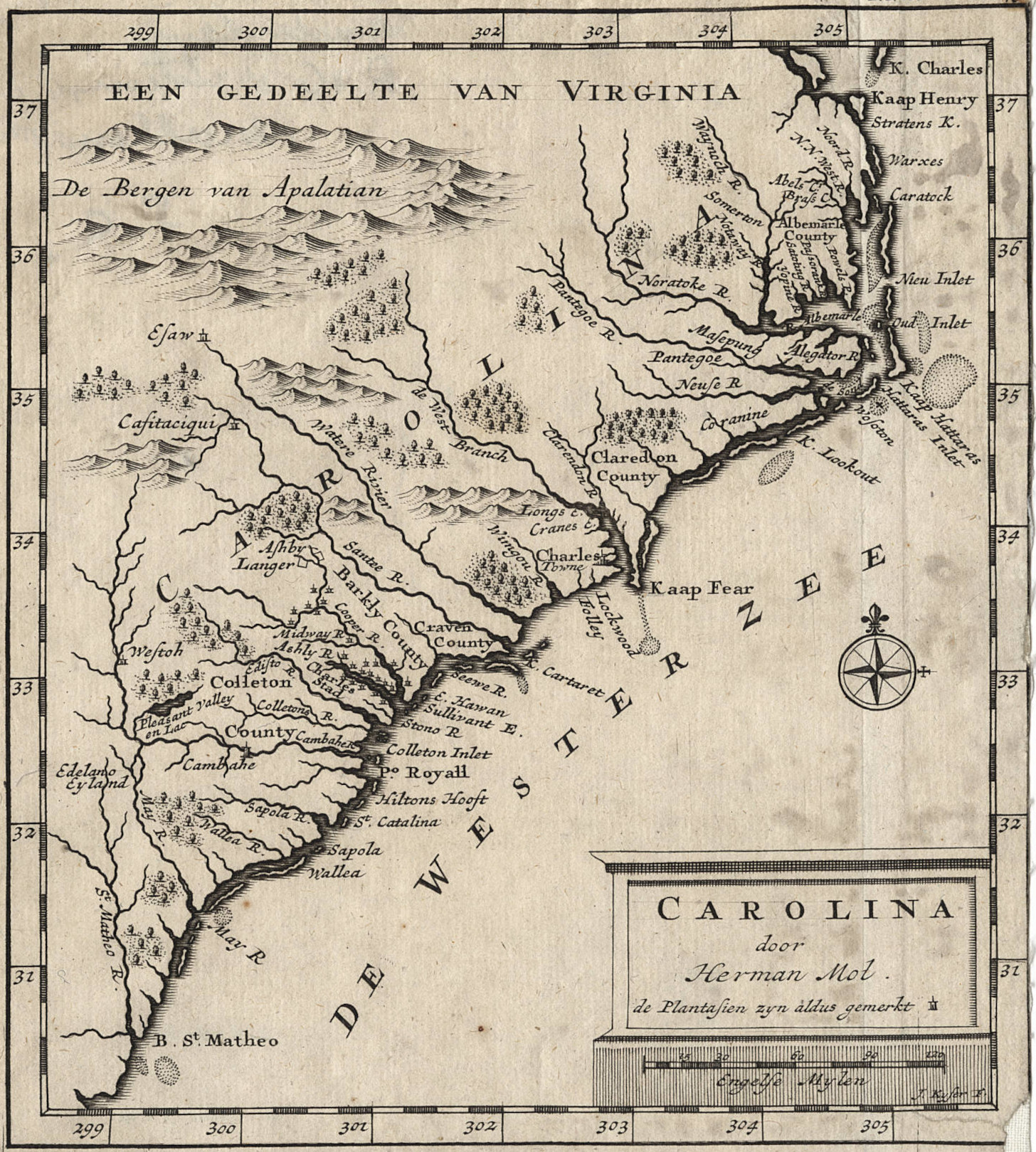
North Carolina’s unique coast offered peril and possibility for both sides during the American Revolution. It has the largest coastline of the original 13 states. Today this measures 1,200 miles, including the ragged edge inside the line of barrier islands now called the “Outer Banks,”1 with 320 facing the ocean. That line is punctured by nearly two dozen cuts or “inlets,” the number and locations changing over the years as storms closed or opened them. Only three were deep and wide enough to allow ocean-going ships through in the 1770s, and shifting sands constantly changed the inlets’ bottoms. Unless captains knew the waters well, they waited outside the inlets for local guides called “pilots” to row out—most of them African-American, some enslaved—who knew where the shallow areas were (“shoals” or “bars”). Otherwise the ships risked getting stuck or punctured.
That’s why pirates of the early 1700s, like Edward Teach (“Blackbeard”), often hid in North Carolina. By knowing the coastline well, they could escape warships chasing them. The same situation favored local merchants trying to take out trade goods and bring in supplies during the Revolution. Those ships faced the British Royal Navy, the most powerful in the world, which set a blockade to catch them. Though it only had to guard the bigger inlets, those were far apart, and the British had few gunships small enough to navigate the shoals.
Their ships needed supplies, so as early as December 1775, they were raiding coastal farms and settlements. A rebel Council of Safety was running the state in place of the royal governor, then living on a gunship off modern Southport. It wrote, “‘We are endeavoring to take steps to protect our inlets from tenders (British supply boats) with which they have lately been infested.’” The rebel legislature, the Provincial Congress, agreed to purchase three ships and convert them for war, naming boards of commissioners for each.
The first, purchased a month later, was a brigantine or “brig”—ship with two masts and square sails—named for George Washington. North Carolina had a navy before it was a state!
Prolonged Preparations
The first battles involved getting the ships ready. The George Washington took six months to “fit out” in Wilmington. The council spent £2,000 to buy it (around $350,000 in modern money). The commissioner in charge, John Forester, complained 18 months later he needed another £2,000 for supplies, despite having spent a lot of his own money. The commissioners were also having trouble finding a crew. “‘Most of the seamen have already enlisted in the land service’” or gone to ports where the pay was higher, Forester wrote the Council of Safety. “‘I see no prospect of her being manned.’” Sure enough, it never filled its crew. The state sent yet another £2,000 to hire one, but Forester had been dead a month when that arrived.

The Pennsylvania Farmer, bought in February 1776 in New Bern, would eventually have 16 cannons and 10 smaller “swivel guns.” A foundry was set up on the Trent River to cast cannonballs. The Farmer’s commissioners recruited its crew of 110 right away, which proved a mistake. The men waited onboard and got bored during its six months of fitting out.
One of the commissioners was the publisher of the North Carolina Gazette newspaper, James Davis. He wrote the council that the officers could not, or would not, maintain discipline. On average each man drank a pint of rum each morning, Davis claimed. “‘This combined with inactivity, instigated both fights and mischief. The most daring insults on inhabitants of New Bern are suffered to pass with impunity.’”2
Davis called the crew, a mix of English, Irish, Scot, and Native American, “‘the most abandoned sett [sic] of wretches ever collected together.’” He was biased, however. The boat was anchored off his plantation, subjecting his corn fields to raids. Mixed crews were common. Blacks served side by side with whites on ships, and could even be in command of them. Enslaved Blacks were considered less likely to desert than whites, for fear of their families being sold.
The Farmer’s crew would use passing boats for target practice, once sending a bullet within inches of a local militia captain. Davis complained to the local authorities, “They came to my landing and destroyed a boat… cut her up for firewood and took out every bolt and spike nail.”
Two officers and several men tried to defect to the British fleet off Virginia, using a stolen boat, but were caught near the border. Incredibly, they were allowed to return to the Farmer. Capt. Joshua Hampstead was brought before the Provincial Congress, but it returned him to duty without censure. This, too, turned out to be a mistake, as you’ll see.

The state also built two “row galleys,” primarily powered by men at oars, though with sails for extra power. These had 16 guns each, including large 24-pounders fore and aft and nine-pounders on the rails between. (The names refer to the weight of cannon ball they fired; for comparison, the largest likely used in N.C. on land during the war were six-pounders.3) The first galley, named Caswell after the first state governor, took two years to build, due in part to a lack of skilled workers. Finally launched in late 1777, it was 75 feet long and 25 at the widest point (“beam”), with two decks and a crew of 145.4
These boats may sound too small to be useful. But similar whaleboats had surprising successes in New England. Those used speed and sheer numbers to overwhelm larger British ships, in a naval version of the guerrilla tactics Patriots often used on land.5
A major reason N.C.’s navy struggled to get sailors was the men had a more lucrative option.
Legal Pirates

As the state and Continental navies were getting started in 1775, shipowners began converting some of their vessels into “privateers.” These operated like pirates, but were authorized by a government using a “letter of marque” to attack ships owned by, or supplying, an enemy in wartime. American privateers had to post a bond as a guarantee they would follow the rules set by the Continental Congress.
Privateers relied on surprise, sailing with their guns covered and no flags until they closed on their prey. Once taken to a safe port, the prize’s papers were examined in a Court of Admiralty to confirm its connection to an enemy. New Bern established one in June 1776.6 Privateer owners got half the profits, and the rest were distributed among the crew. The lowest-ranked men could earn in a single voyage the equal of years of wages, on top of base pay twice that of the regular navy’s. But only a small percentage of privateer trips were successful.
International law had long allowed privateering. But the British Parliament passed a Pirate Act in 1777 specifying that Americans who claimed to be privateers were just pirates, because the rebel government was not legal in its eyes. Controversial in Britain, it denied American “privateersmen the legal rights typically granted to prisoners of war, (and) allowed them to be held without trial or prospect of exchange.”7 In other words, they were treated worse than common criminals.
The act also authorized British privateers against the rebel colonies. Eventually England had more than 1,100 sailing from occupied New York City, Britain, and the West Indies. In comparison, by 1781 the United States only had 500.8
British privateers harassed the N.C. coast for the rest of the war. The Gazette reported in April 1778 that a single-mast ship (“sloop”) with four cannons and 30 sailors took two French traders just inside the Ocracoke Bar with a large amount of much-needed salt and 100 barrels of tobacco.9

North Carolina privateers had some successes, too. In Fall 1777 the Nancy captured two ships with combined cargos worth £75,000, including rum and enslaved people. The 16-gun Bellona came into New Bern with four captive ships the next September. After the disastrous Continental defeat at the 1780 Battle of Camden (S.C.), the army was largely resupplied through the capture of two prizes brought into Wilmington with £50,800 worth of supplies by the General Nash.
The brother of that ship’s namesake, Gov. Abner Nash, wrote that even row galleys with 40–50 men were successful. Two that went out together from New Bern captured 12 ships and burned four. Other wins included:
- The Buckskin engaging British raiders and making a cargo run to France.
- The Lydia capturing enslaved Africans and goods worth up to £30,000. Imported slaves could not be sold here under state law, so they were taken to Georgia.
Altogether, privateers proved better protectors of the coast than the state’s navy.
A Checkered Record
The General Washington was at the N.C. town renamed for the general when the Council of Safety ordered it to “‘proceed with all possible dispatch to Ocracoke Bar and there protect the trading vessels’” in October 1776.10 Nothing appears to have come from the order, probably due to the lack of a crew. After two years of no notable accomplishments, the state tried but failed to sell the brig in February 1778. A couple months later it was used as a prison ship. British prisoners offered to switch sides and serve on it, to no avail. It then disappears from the records.

In August 1777, the Pennsylvania Farmer was sent to Core Sound, off modern Morehead City. Once there, Capt. Hampstead learned three British ships had been patrolling between capes Lookout and Hatteras, panicked, and fled up the Neuse River. Leaders in both Beaufort and New Bern complained to the General Assembly about the British ships. The former stated, “‘If something is not done to keep them from laying within our bar, we shan’t have a single vessel coming in and (this) will prevent our getting any further supply of salt or anything else from the West Indies.’”
The Gazette chimed in, “‘The utmost dispatch is needed to drive these sheep stealers from whence they came.’” Gov. Richard Caswell ordered militia patrols, which didn’t help much.
Caswell then ordered the Farmer to the West Indies on a supply run, minus a few deserters angry it wouldn’t be a privateer. When it got back, Hampstead sold its cargo and fled with the cash. The state gave up and tried to sell the ship in Edenton in April 1778. Shipowner and Continental Congress delegate Joseph Hewes supposedly bought it through an agent, but then refused to go through with the sale (sources differ on the reason). It was purposely sunk, only to be raised and re-offered for sale the next year, which is the last time it appears in the records.
The Caswell may have scared off some British raiders while stationed at Ocracoke, but it operated less than two years before sinking, as of December 1779.11
The brig King Tammany, built in Edenton, had 12 cannons and 10 swivel guns. But one of its commissioners wrote Hewes, “‘No good man can be found that will take command of her… Once they discover they are to protect Ocracock Inlet, not to privateer, many desert.’” So it was sent on a privateering mission, which failed, and the captain became a privateer soon after. The state decided it was not useful as a warship. After repairs in Edenton, it was sent to the West Indies to trade tobacco for salt. The Tammany continued making trade runs on behalf of the state until it, too, disappeared from the records after July 1780.12
In short, the ships of the North Carolina Navy never fought a pitched battle, and whatever remains of them, if anything, lies in waters unknown.
Naval Connections

North Carolina saw other naval actions, and had connections to the regular navies:
- British fleets from New York and Ireland filled the mouth of the Cape Fear River off Fort Johnston (now Southport) in Spring 1776, with troops meant to reclaim N.C. for the king. When Loyalist support disappeared due to the Battle of Moore’s Creek Bridge, the fleet sailed for Charleston.
- Before the fleet left, a couple of ships tried to reach the Loyalist stronghold of Cross Creek (today’s Fayetteville). They could not navigate the river north of Wilmington, attempted a raid on the town, and were driven off by Patriot militia.
- Joseph Hewes was on the Navy and later Marine committees of the Continental Congress that created the United States Navy.13
- Hewes recommended the commission of John Paul Jones. Jones probably lived for a time with political leader Willie Jones of Halifax and borrowed his last name, before going on to become one of America’s first naval heroes.
- Many North Carolinians served on military or merchant ships throughout the war. A 1780 petition from Carteret County said, “‘nearly all the young and able-bodied men belonging to the said County have gone to sea.’”14
- A British force that occupied Wilmington in 1781 included a few gunboats and galleys left behind by the naval force that brought it. The corps’ commander, Maj. James Craig, was not sorry to see the navy commander leave. In a letter to his boss he repeated a complaint common to relations between British land and sea forces, which operated independently: “‘he & I differ so much in our sentiments that I much fear we can never carry on service together… effectually.’”15
- Charles Biddle, brother of highly successful Continental Capt. Nicholas Biddle, helped set up a small fort in Beaufort before serving as a privateer out of Philadelphia. The fort failed to stop the last British supply raid by sea in North Carolina in 1782.
More Information
- Allen, Gardner N., A Naval History of the American Revolution (Houghton Mifflin Company, 1913), Vol. I
- Borick, Carl P., Relieve Us of This Burthen: American Prisoners of War in the Revolutionary South, 1780-1782 (University of South Carolina Press, 2012)
- Claypool, Edward A., Moore-Lowe-Lewin Genealogy of North Carolina (Chicago, IL, 1905)
- Coastal Facts’, North Carolina Beach, Inlet & Waterway Association, n.d. <https://www.ncbiwa.org/coastal-facts/> [accessed 29 August 2025]
- Conner, R. D. W., North Carolina: Rebuilding an Ancient Commonwealth, 1584-1925 (The Lewis Publishing Company, 1919), Volume 1, The Colonial and Revolutionary Periods, 1584-1783
- Crittenden, Charles Christopher, ‘Ships and Shipping in North Carolina, 1763-1789’, The North Carolina Historical Review, 8.1 (1931), pp. 1–13
- Daughan, George, If by Sea: The Forging of the American Navy—From the American Revolution to the War of 1812 (Basic Books, 2008)
- Day, Jean, Revolutionary Patriots Along the North Carolina Coast, ed. by Hervie Day (Golden Age Press, 2006)
- Dill, Alonzo Thomas, Governor Tryon and His Palace (The University of North Carolina Press, 1955)
- Dunkerly, Robert M., Redcoats on the Cape Fear: The Revolutionary War in Southeastern North Carolina, Revised (McFarland & Company, Inc., Publishers, 2012) ‘Facts About NC Beaches’, Visit North Carolina, n.d. <https://media.visitnc.com/Facts-About-NC-Beaches> [accessed 29 August 2025]
- Lewis, J. D., ‘The NC Navy – The American Revolution in North Carolina -’, Carolana, 2016 <https://www.carolana.com/NC/Revolution/revolution_nc_navy.html> [accessed 22 September 2025]
- Loy, Ursula Fogleman, and Pauline Marion Worthy (eds), Washington and the Pamlico (Washington-Beaufort County Bicentennial Commission, 1976)
- Miller, Nathan, Sea of Glory: The Continental Navy Fights for Independence, 1775-1783 (D. McKay Co, 1974)
- Parramore, Thomas, ‘John Jasper White’, North Carolina Bicentennial Newsletter, Bicentennial Section, Division of Archives and History, N.C. Dept. of Cultural Resources, 4 July 1776, State Library of North Carolina, Government and Heritage Library
- Patton, Robert H., Patriot Pirates: The Privateer War for Freedom and Fortune in the American Revolution, 1st ed. (Pantheon Books, 2008)
- Paullin, Charles Oscar, ‘The Navy of the American Revolution: Its Administration, Its Policy and Its Achievements’ (Doctoral dissertation, The University of Chicago, published by The Burrows Brothers Co., 1906) <http://archive.org/details/navyofamericanre00paul>
- Preston, Antony, David Lyon, and John Batchelor, Navies of the American Revolution (Prentice-Hall, 1975)
- Reed, C. Wingate, Beaufort County: Two Centuries of Its History (1962)
- Still, Jr., William, North Carolina’s Revolutionary War Navy, North Carolina Bicentennial Pamphlet Series (Theo. Davis Sons, Inc., 1976)
1 “Coastal Facts”; “Facts about NC Beaches.”
2 This section is mostly based on Still (1976) and Day (2006), the most comprehensive books on the coastal war as of 2025. Facts were checked with and supplemented from other sources including the Colonial and State Records. Direct quotations are from Day unless otherwise footnoted.
3 The Continental Army used six-pounders at the Battle of Guilford Court House. N.C. militia regiments at the Battle of Moore’s Creek Bridge owned nine-pounders, but no documents from the day prove those were at the battle.
4 The ship was a joint venture with Virginia, whose ports were blocked by a British fleet at the mouth of Chesapeake Bay. It was built in the inland river port of South Quay, Va. The states argued over payments past the end of the war, with Virginia claiming N.C. owed it money (Day 2006).
5 Daughon 2008.
6 Hessel 1983.
7 Patton 2008.
8 Patton.
9 Conner 1919.
10 The date of this letter proves the town was the first in the brand-new United States named for Washington (Loy and Worthy 1976).
11 Paullin.
12 Day.
13 Daughan 2008.
14 Quoted in Crittendon 1931.
15 Quoted in Dunkerly 2012.